Thursday, October 30, 2014

The 13 hottest real estate markets in America

 The real estate bubble that burst in 2006 took six additional years to entirely deflate, with home prices hitting rock bottom in 2012. But by 2014, home prices, on average, have returned to their pre-bubble norms.
And with the economy growing only modestly, and average incomes growing slowly, there isn’t a lot of reason to expect that home price appreciation will do much more than keep up with inflation in coming years. But that’s on a national level, and local markets behave much differently. In fact, there are several markets in America where analysts argue that–when compared to historical trends, incomes, and rents–current prices look overvalued.
Real estate data firm Trulia compiles statistics on both the amount of home price appreciation in each U.S. metro area as well as estimates of how overvalued homes are in those areas compared with historical trends. According to Trulia, even if many of these metro areas appear overvalued, there’s no reason to believe that we should expect a crash in prices anytime soon, as we’re nowhere near the price levels we saw in the years leading up to the housing crisis. At the same time, prospective buyers in these areas should realize that real estate is pricey there, and perhaps temper their expectations for price appreciation to continue indefinitely.
By combining Trulia’s estimates on cities with overvalued real estate with figures on the speed at which prices have gone up year-over-year as of August 2014, we present the 13 hottest real estate markets in the country:
1. Austin, Texas
2. Riverside-San Bernadino, CA.
3. Los Angeles, CA.
4. San Francisco, CA.
5. Orange County, CA.
6. Miami, Florida
7. San Jose, California
8. Oakland, California
9. West Palm Beach, Fla.
10. Houston, Texas
11. Honolulu, Hawaii
12. Denver, Colorado
13. Portland, Oregon

Monday, October 27, 2014

Foreclosures fall to post-recession low

In a sign of health for San Diego County’s housing market, the number of foreclosures in the region fell to a post-Great Recession low in September. 
Last month, lenders foreclosed on 121 properties in San Diego County, the fewest since 109 homes were repossessed in June 2006, the midst of the housing bubble that led to the economic downturn, CoreLogic DataQuick reports. 
“To me the fact that we’re hitting a low in foreclosures is consistent with being in a very strong market,” said Mark Goldman, a loan officer and real-estate lecturer at San Diego State University.
The number of foreclosures in September was down from 137 in August, and 146 in September 2013. 
Foreclosures, which peaked at 2,004 in July 2008, have been trending downward over the last several years as San Diego County home prices have rebounded since the Great Recession. In September, the median price for a home in the county was $445,000, up from the bottom $280,000 in January 2009. The equity gained since then has given people an out if they can’t pay their mortgage: they can sell their home to avoid default.
“Foreclosures occur when people are upside down,” Goldman said. “There’s always things that can go wrong in the market, I would be amazed if we ever saw zero foreclosures, but I think that’s low and consistent with a very stable, maybe even a robust market.”
In September, foreclosure resales made up 3.3 percent of transactions in the county. Norm Miller, a real-estate professor at the University of San Diego, said about six months ago the university stopped using foreclosures in its models for predicting prices.
“The home prices have gone up enough now that we’re not seeing strategic defaults anymore,” he said. “There are a few pockets still with lingering inventory, and still some even here, but they’re not enough of the market to drive prices the way they were.”
Despite foreclosures subsiding, Goldman said he would continue to monitor them as one of several indicators of how the housing market is faring. However, he doesn’t consider them as important as gauges like inventory, number of sales, price, and default notices, which trigger the foreclosure process. 
CoreLogic DataQuick reports the default notices fell to 398 in September, down from 422 in August and 466 a year earlier. Default notices peaked at 3,832 in March 2009. Goldman said he considers those a better indicator because banks will foreclose depending on the time of year, whereas default notices occur after 90 days of missed payments. Compliments of the Union Tribune.

Home Sales Hit Highest Level of the Year

Home Sales Hit Highest Level of the Year | Keeping Current Matters
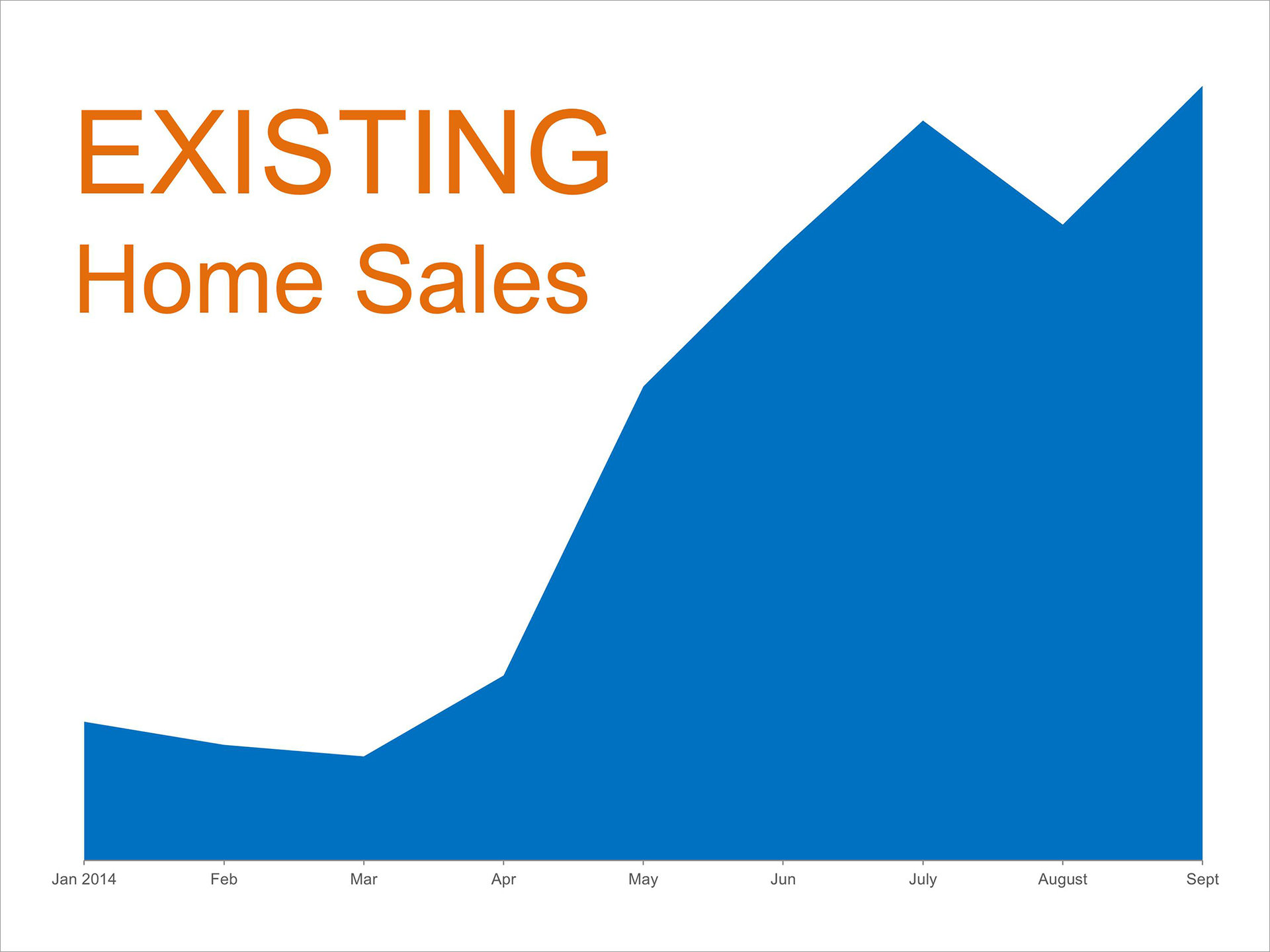
The National Association of Realtors (NAR) released their Existing Home Sales Reportearlier this week. The report revealed that “sales bounced back in September to their highest annual pace of the year”. As the chart below shows, after a very slow start at the beginning of the year, residential home sales have been increasing nicely.
Home Sales Hit Highest Levels of 2014 | Keeping Current Matters

3 Questions to Ask Before Buying a Home

3 Questions to Ask Before Buying a Home | Keeping Current Matters
If you are thinking about purchasing a home right now, you are surely getting a lot of advice. Though your friends and family have your best interests at heart, they may not be fully aware of your needs and what is currently happening in real estate. Let’s look at whether or not now is actually a good time for you to buy a home.
There are three questions you should ask before purchasing in today’s market: 

1. Why am I buying a home in the first place?

This truly is the most important question to answer. Forget the finances for a minute. Why did you even begin to consider purchasing a home? For most, the reason has nothing to do with finances. A study by the Joint Center for Housing Studies at Harvard University reveals that the four major reasons people buy a home have nothing to do with money:
  • A good place to raise children and for them to get a good education
  • A place where you and your family feel safe
  • More space for you and your family
  • Control of the space
What non-financial benefits will you and your family derive from owning a home? The answer to that question should be the biggest reason you decide to purchase or not.

2. Where are home values headed?

When looking at future housing values, Home Price Expectation Survey provides a fair assessment. Every quarter, Pulsenomics surveys a nationwide panel of over one hundred economists, real estate experts and investment & market strategists about where prices are headed over the next five years. They then average the projections of all 100+ experts into a single number.
Here is what the experts projected in the latest survey:
  • Home values will appreciate by 4% in 2015.
  • The cumulative appreciation will be 19.5% by 2018.
  • Even the experts making up the most bearish quartile of the survey still are projecting a cumulative appreciation of over 11.2% by 2018.

3. Where are mortgage interest rates headed?

A buyer must be concerned about more than just prices. The ‘long term cost’ of a home can be dramatically impacted by an increase in mortgage rates.
The Mortgage Bankers Association (MBA), the National Association of RealtorsFannie Mae and Freddie Mac have all projected that mortgage interest rates will increase by approximately one full percentage over the next twelve months.

Bottom Line

Only you and your family can know for certain the right time to purchase a home. Answering these questions will help you make that decision. Thinking of buying or have any questions feel free to call my office for a FREE consultation at 619.449.1919.

Monday, October 20, 2014

Fannie Mae Agrees: Hire a Pro to Sell Your House

Fannie Mae Agrees: Hire A Pro to Sell Your House | Keeping Current Matters
Do you really need an agent to sell your house in today’s market? Here’s what Fannie Mae suggests to sellers on the Know Your Options section of their website:
“Select how you'll market and list the home (e.g., with a real estate agent or for sale by owner). There are pros and cons to each, but unless you are experienced at selling homes, it usually makes financial sense to get professional help—homes sold by agents typically sell at a higher price and spend less time on the market. An agent will also help you determine the best pricing for the house, they'll market the home, and they'll be your advocate throughout the process.”

Let’s go over the points they made:

  • Homes sold by agents typically sell at a higher price
  • Homes sold by agents typically spend less time on the market
  • An agent will help you determine the best pricing for the house
  • An agent will market the home
  • An agent will be your advocate throughout the process
If Fannie Mae says using an agent probably makes sense, perhaps you should interview an agent before putting your house up for sale.

5 Demands to Make on Your Real Estate Agent

5 Demands to Make on Your Real Estate Agent | Keeping Current Matters
Are you thinking of selling your house? Are you dreading having to deal with strangers walking through the house? Are you concerned about getting the paperwork correct? Hiring a professional real estate agent can take away most of the challenges of selling. A great agent is always worth more than the commission they charge just like a great doctor or great accountant.
You want to deal with one of the best agents in your marketplace. To do this, you must be able to distinguish the average agent from the great one.
Here are the top 5 demands to make of your Real Estate Agent when selling your house:

1. Tell the truth about the price

Too many agents just take the listing at any price and then try to the ‘work the seller’ for a price correction later. Demand that the agent prove to you that they have a belief in the price they are suggesting. Make them show you their plan to sell the house at that price – TWICE! Every house in today’s market must be sold two times – first to a buyer and then to the bank.
The second sale may be more difficult than the first. The residential appraisal process has gotten tougher. A recent survey showed that there was a challenge with the appraisal on 24% of all residential real estate transactions. It has become more difficult to get the banks to agree on the contract price. A red flag should be raised if your agent is not discussing this with you at the time of the listing.

2. Understand the timetable with which your family is dealing

You will be moving your family to a new home. Whether the move revolves around the start of a new school year or the start of a new job, you will be trying to put the move to a plan.
This can be very emotionally draining. Demand from your agent an appreciation for the timetables you are setting. You agent cannot pick the exact date of your move, but they should exert any influence they can, to make it work.

3. Remove as many of the challenges as possible

It is imperative that your agent knows how to handle the challenges that will arise. An agent’s ability to negotiate is critical in this market.
Remember: If you have an agent who was weak negotiating with you on the parts of the listing contract that were most important to them and their family  (commission, length, etc.), don’t expect them to turn into Super hero when they are negotiating for you and your family with your buyer.

4. Help with the relocation

If you haven’t yet picked your new home, make sure the agent is capable and willing to help you. The coordination of the move is crucial. You don’t want to be without a roof over your head the night of the closing. Likewise, you don’t want to end up paying two housing expenses (whether it is rent or mortgage). You should, in most cases, be able to close on your current home and immediately move into your new residence.

5. Get the house SOLD!

There is a reason you are putting yourself and your family through the process of moving.
You are moving on with your life in some way. The reason is important or you wouldn’t be dealing with the headaches and challenges that come along with selling. Do not allow your agent to forget these motivations. Constantly remind them that selling the house is why you hired them. Make sure that they don’t worry about your feelings more than they worry about your family. If they discover something needs to be done to attain your goal (i.e. price correction, repair, removing clutter), insist they have the courage to inform you.

Good agents know how to deliver good news. Great agents know how to deliver tough news. In today’s market, YOU NEED A GREAT AGENT!

Thursday, October 16, 2014

Is it a good time to Sell in San Diego

Here in San Diego according to our local MLS (multiple listing service) we currently have 6,608 detached homes for sale and 2,094 condos and town homes for sale which is a total of 8,702.

With that said last 30 days back from today San Diego has sold 2,365 condos and homes. Given that information we currently have about a 3.5 month supply of homes should nothing else come on the market.

A normal market is around a 6 month inventory at any given time. With that said being that we only have a 3.5 month supply of condos/homes for sale that means chances of you selling your home now for top dollar is excellent. Reasons being, there is less competition, buyers are out there buying, interest rates are low and inventory is being sucked up.

So is it a good time to sell in San Diego? Given the facts, I would say yes. If you or anyone you know wants a free market analysis on your home emailed to you every month keeping you up to date on the price of your home and whats happening in your neighborhood send me your name, address and phone number via email at Tony@TonyRElias.com and I will enroll you in our service.

Have a great day