Monday, March 16, 2015

Location, Location, Location

Location, Location, Location | Keeping Current Matters
A recent Demand Institute report revealed “nearly half of all American households plan to move at some point in the future.”
Seventy-five percent of those surveyed in the report cited one or more ‘location-related reasons’ for their eagerness to move. Here are the top 5 reasons:
  1. Safer Neighborhood – 30%
  2. Closer to Family – 27%
  3. Change of Climate – 26%
  4. Closer to Work – 25%
  5. For a New Job – 23%
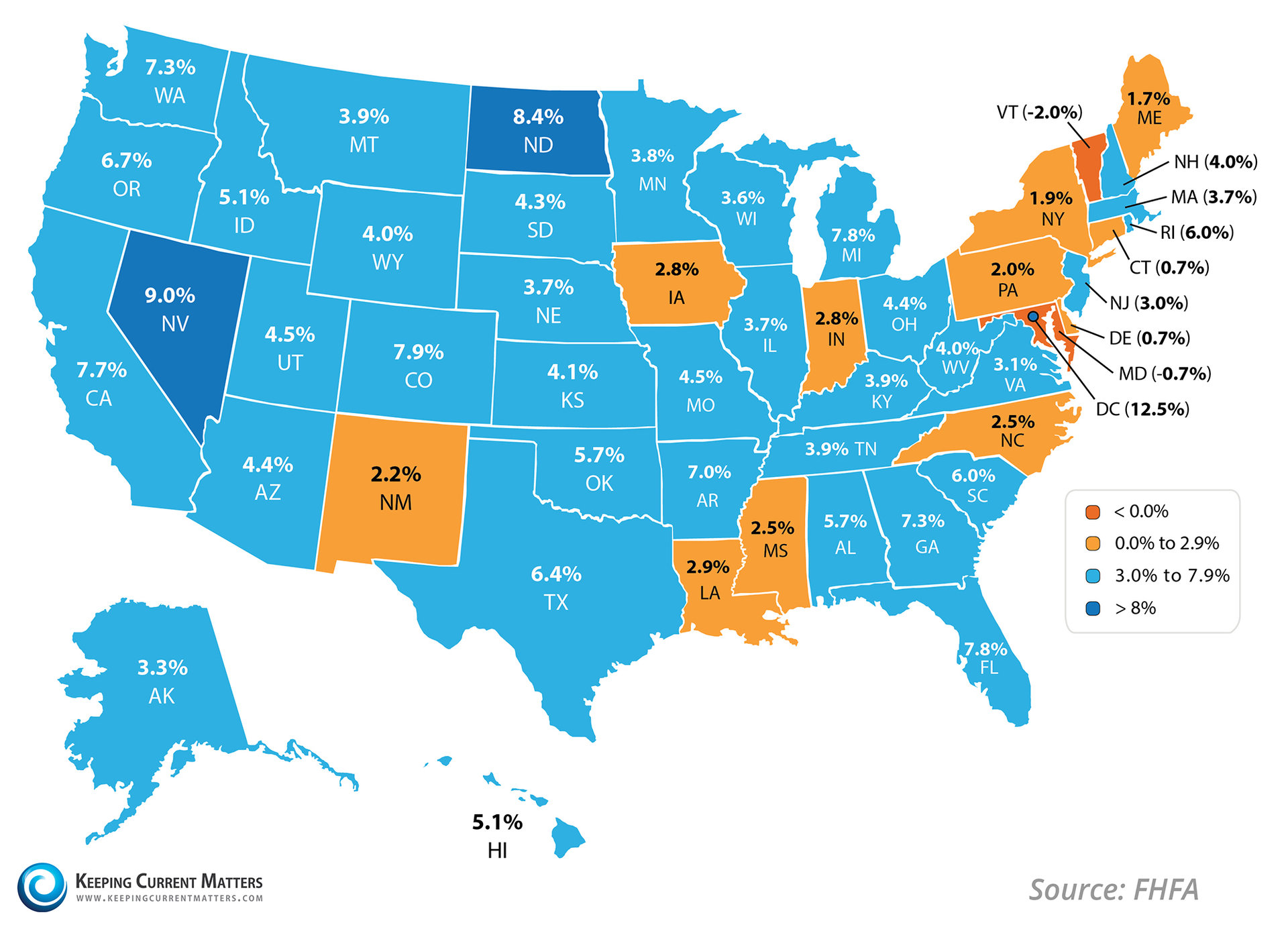
While the majority of Americans (74%) will move within their home state, for the 26% planning to call a new state home, it is important to know that prices in each state are appreciating at different rates and waiting to buy or sell your home could cost you more in the long run.
The map below was created using the FHFA’s latest Home Price Index and shows year-over-year price gains in each state.
Year-Over-Year Price Gains | Keeping Current Matters

Bottom Line

If your plan for 2015 includes relocating to a new state, meet with a local real estate professional in that area who can help you find the best fit for you and your family’s needs.

Wednesday, March 11, 2015

Is the Housing Market Back? Ask Lowes & Home Depot!

Is the Housing Market Back? Ask Lowes & Home Depot! | Keeping Current Matters
A recent Bloomberg Business article reports that both Lowes & Home Depot experienced fourth quarter profits that beat revenue projections by the most in six quarters. So what does that mean to the housing market?

Consumer Confidence

Lowe’s Chief Executive Officer Robert Niblock said,
“Consumers are feeling better about their jobs, their wages and certainly feeling better about the value of their home, they are re-engaging in projects that they have put off.”
Sales to professional contractors have increased significantly as well, and were a driving factor in the quarter. Home Depot’s Chief Financial Officer Carol Tome calls this a “sign of health. If they are putting more items in their basket, it means they have work coming at them.”

Home Values Rising

In a quarterly consumer survey conducted by Lowe’s since 2007, the percentage of respondents who said that the value of their home is rising increased to its highest value ever, at 50%.
Whether Americans are finally adding that man-cave they’ve always wanted, or renovating a master suite, an increased confidence in the value of one’s home often sparks homeowners to invest in big-ticket projects.
The National Association of Realtors (NAR) reports that the median price of an existing home (for all housing types) rose year-over-year for the 35th consecutive month.
Not all who are renovating are planning on staying in their home. The Demand Institute reports that “nearly half of American households plan to move at some point in the future.”
For those who are planning on listing their home this spring, spending the time and money needed to update that 1950’s bathroom or kitchen can fetch higher prices in today’s market.

Bottom Line

Meeting with a local real estate professional can give you insight into the small (or big) improvements your home could use to draw the highest price and return on investment this spring.

FSBO’s Must Be Ready to Negotiate

FSBO’s Must Be Ready to Negotiate | Keeping Current Matters
Now that the market has showed signs of recovery, some sellers may be tempted to try and sell their home on their own (FSBO) without using the services of a real estate professional.
Real estate agents are trained and experienced in negotiation. In most cases, the seller is not. The seller must realize their ability to negotiate will determine whether they can get the best deal for themselves and their family.
Here is a list of some of the people with whom the seller must be prepared to negotiate if they decide to FSBO:
  • The buyer who wants the best deal possible
  • The buyer’s agent who solely represents the best interest of the buyer
  • The buyer’s attorney (in some parts of the country)
  • The home inspection companies which work for the buyer and will almost always find some problems with the house.
  • The termite company if there are challenges
  • The buyer’s lender if the structure of the mortgage requires the sellers’ participation
  • The appraiser if there is a question of value
  • The title company if there are challenges with certificates of occupancy (CO) or other permits
  • The town or municipality if you need to get the COs permits mentioned above
  • The buyer’s buyer in case there are challenges on the house your buyer is selling.
  • Your bank in the case of a short sale

Bottom Line

The percentage of sellers who have hired a real estate agent to sell their home has increased steadily over the last 20 years. Meet with a professional in your local market to see the difference they can make in easing the process.

Monday, March 2, 2015

Selling Your Home? The Importance of Using an Agent

Selling Your Home? The Importance of Using an Agent | Keeping Current Matters
When a homeowner decides to sell their house, they obviously want the best possible price with the least amount of hassles. However, for the vast majority of sellers, the most important result is to actually get the home sold.
In order to accomplish all three goals, a seller should realize the importance of using a real estate professional. We realize that technology has changed the purchaser’s behavior during the home buying process. For the past two years, 92% of all buyers have used the internet in their home search according to the National Association of Realtors’ most recent Profile of Home Buyers & Sellers.
However, the report also revealed that for the second year in a row 96% percent of buyers that used the internet when searching for a home purchased their home through either a real estate agent/broker or from a builder or builder’s agent. Only 2% purchased their home directly from a seller whom the buyer didn’t know.
Buyers search for a home online but then depend on an agent to find the actual home they will buy (53%) or negotiate the terms of the sale & price (31%) or understand the process (63%).
Stephen Phillips, the Chief Operating Officer for HSF Affiliates LLC, put it best:
“Home buyers are more informed than ever with their Internet searches and ongoing research; however, there’s a critical need to transform that information into analysis and advice that helps consumers make the best home-buying and selling decisions.
The plethora of information now available has resulted in an increase in the percentage of buyers that reach out to real estate professionals to “connect the dots”. This is obvious as the percentage of overall buyers who used an agent to buy their home has steadily increased from 69% in 2001.

Bottom Line

If you are thinking of selling your home, don’t underestimate the role a real estate professional can play in the process.

Monday, February 23, 2015

Homeownership Rates: Are They Really Crashing?


Homeownership Rates: Are They Crashing? | Keeping Current Matters
The Census recently released their 2014 Homeownership Statistics, and many began to worry that Americans have taken a step back from the notion of homeownership.

Easy… Chicken Little

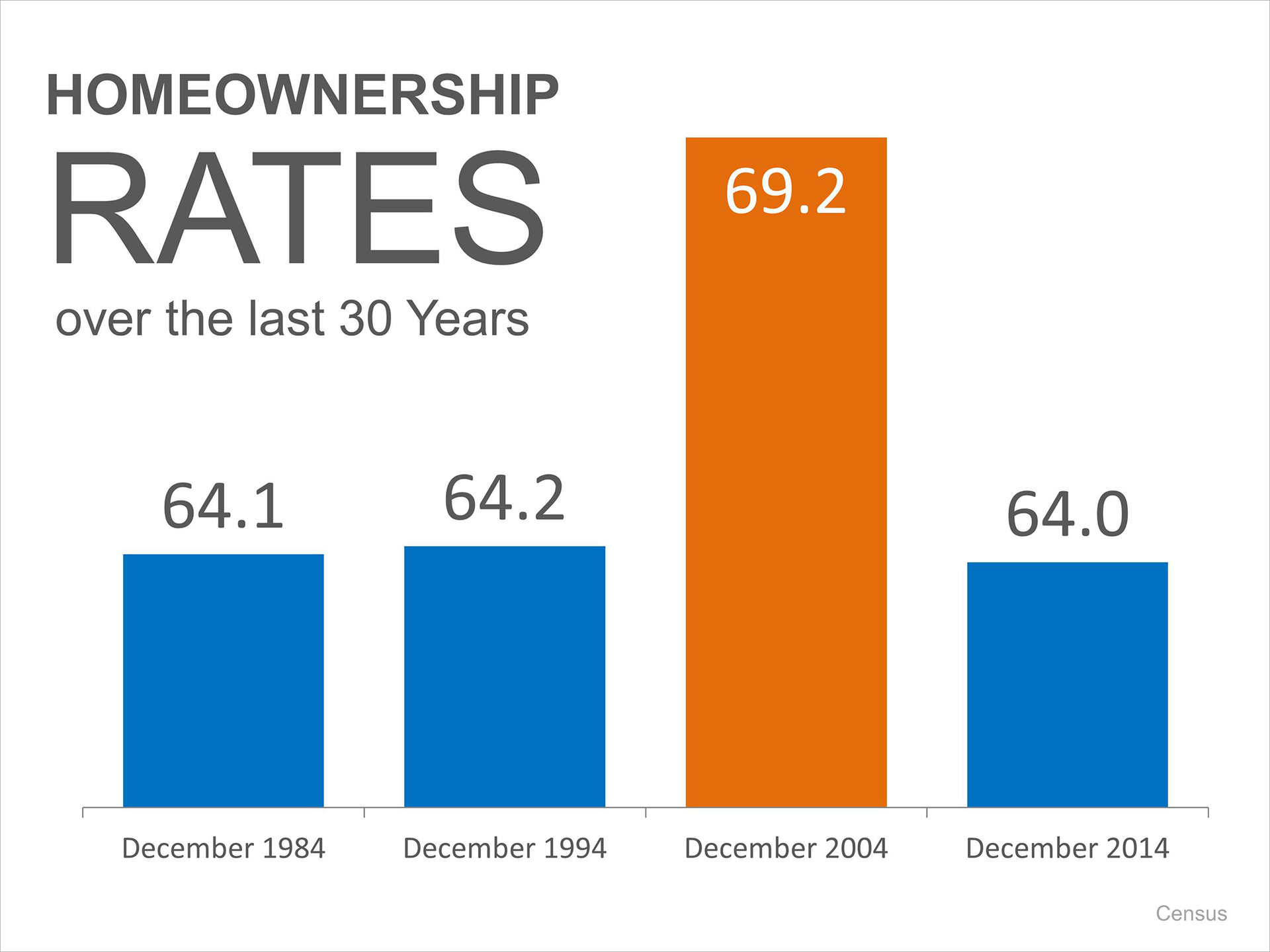
The national homeownership rate peaked in 2004, representing a 69.2% of Americans who bought vs. rented their primary residence. Many have noticed a decline in rate since then and taken that as a bad sign.
However, if you look at the national rate over the last 30 years (1984-2014), you can see that the current homeownership rate has returned closer to the historic norm. 2014 ended the year with a rate of 64% just under the rate in 1985 and 1995.
Homeownership Rates Historically | Keeping Current Matters

Bottom Line 

With interest rates and prices still below where experts predict, evaluate your ability to purchase a home with a local real estate professional.

5 Housing Trends in Winter 2015

5 Housing Trends in Winter 2015
By Polyana da Costa
RISMEDIA, Monday, February 23, 2015— (TNS)—If you think winter is not a good season to buy and sell a home or get a mortgage, you may want to reconsider. Buyers and homeowners seeking to refinance will find some good news this season—but they need to act soon.

Buyers will find somewhat easier standards when trying to get a mortgage, and some may encounter lower down payment requirements. Those who want to refinance, especially homeowners with variable-rate loans, will have a second chance to grab a low fixed rate.

Here are five housing trends you should expect to see during winter.

Lending Standards Loosen Up

It might get a little easier for some borrowers to get mortgages during winter. Increased competition among lenders and recent efforts by mortgage giants Fannie Mae and Freddie Mac should contribute to easier standards.

Fannie and Freddie are not direct lenders. They set the guidelines for the types of loans they are willing to buy. Many lenders have been imposing stricter requirements when issuing mortgages to avoid the risk of lawsuits from Fannie and Freddie. Recently, Fannie and Freddie provided more clarity on when lenders can be penalized for loans that go bad after they’re sold. The revised rules put some lenders more at ease.

The result: more loans.

“I think we may see some more potential lending to make more mortgages available to more buyers.” says Jonathan Corr, president of Ellie Mae. “Right now, they can require you to repurchase the loan for pretty much anything, even small clerical errors.”

Housing Market Stabilizes

Home prices will continue to increase in 2015, but at a slower pace than they have in recent months. That’s not necessarily a bad sign for the housing market. Rather, it’s the beginning of a stable market, says Phil Huff, CEO of Platinum Data Solutions.

“I think this is the beginning of the new norm,” he says. “I don’t expect to see pressure on prices one way or another.”

Nationwide, prices are expected to rise about 4.5 percent by the end of the year, according to Realtor.com. That’s a reasonable increase, and it’s not like the price jumps that buyers saw in the past couple of years.

Still, the winter may be a great time to buy and sell a home.

“Some people feel like now is not necessarily a good time to list, but we continue to see homes move because of low inventory,” says Chad Royle, regional sales manager for Bank of the West in Denver.

Mortgage Rates Are Low—for Now

Mortgage rates have stayed low for much longer than most mortgage experts had expected. This winter may be the last chance for buyers and refinancers to grab rates at the bottom. The Mortgage Bankers Association predicts the 30-year fixed rate will reach 4.4 percent by the end of the first quarter.

That’s slightly higher than where rates are now, but it’s still attractive.

If you have sat on the sidelines, waiting to refinance or buy, you may be in for a surprise if you wait too long. The Federal Reserve is likely to raise the federal funds rate in 2015, and when that happens, mortgage rates will jump, says Brett Sinnott, director of secondary marketing at CMG Mortgage Group in San Ramon, California.

“The clock is ticking,” Sinnott says. “Act now. The first quarter is going to be crucial in getting a loan completed.”

Time to Refinance Helocs?

Many homeowners who borrowed against their equity with home equity lines of credit or other variable-rate loans might want to consider refinancing this winter. Once the Fed raises the federal funds rate, these loans may become more expensive—and borrowers will find higher rates on fixed-rate loans, too, mortgage experts say.

“If someone has a large line (of credit) and rates start jumping, that can drastically impact the individual’s ability to pay the loan,” Royle says. “I would strongly encourage people to consider refinancing into a fixed term now.”

Proactive, Not Reactive

Royle says he has seen a number of people refinancing because they have HELOCs whose draw periods are about to expire. But few people are refinancing because they are aware that rates will rise, he says.

“I think that’s going to be the problem,” he says. “The consumer will be in a reactionary mode. I would encourage people to be proactive and refinance now.”

Lower Down Payments for First-Timers

Fannie Mae has recently announced a program that allows first-time homebuyers to get a mortgage with as little as 3 percent down, instead of the usual minimum of 5 percent. The program is available through state housing finance agencies. At least one of the co-borrowers on the loan must be a first-time buyer.

Homeowners who wish to refinance, but don’t have sufficient equity to refinance through other types of loans, can refinance up to 97 percent of their home’s values. Buyers still have to meet Fannie’s requirements to qualify for a loan, but the program may be helpful to buyers who have not managed to save enough for a down payment.

“They are trying to stimulate the market,” Huff says. “I think it will help some borrowers, but it’s not going to have a major impact on the market.”

©2015 Bankrate.com
Distributed by Tribune Content Agency, LLC

Monday, February 16, 2015

Souther California Market Highlights from December 2014

  • Foreclosure resales represented 5.0 percent of the resale market in December. That was down from a revised 5.5 percent in November 2014 and down from 5.8 percent in December 2013. In recent months the foreclosure resale rate has been the lowest since early 2007. In the current cycle, foreclosure resales hit a high of 56.7 percent in February 2009. Foreclosure resales are purchased homes that have been previously foreclosed upon in the prior 12 months. 
  • Short sales made up an estimated 6.2 percent of resales in December, down from a revised 6.4 in November 2014 and down from 10.2 percent in December 2013. Short sales are transactions in which the sale price fell short of what was owed on the property.
  • Absentee buyers – mostly investors – bought 23.4 percent of the homes sold in December. That was down from a revised 23.8 percent in November 2014 and down from 26.9 percent in December 2013. The December 2014 absentee level ties the October 2014 level as the lowest for any month since October 2010, when 22.1 percent of homes were sold to absentee buyers. The peak absentee share was 32.4 percent in January 2013, and the monthly average since 2000, when CoreLogic DataQuick absentee data began, is about 19 percent. Absentee buyers include those who purchase vacation homes or other properties that public property records suggest are not used as primary residences. 
  • Cash buyers accounted for 23.8 percent of December home sales, down from a revised 24.3 percent in November 2014 and down from 28.8 percent in December 2013. The December 2014 cash level was the lowest for any month since January 2009, when 22.0 percent of homes were bought with cash. The peak was 36.9 percent in February 2013, and the monthly average since 1988 is 16.7 percent.
  • Southern California home buyers committed a total of $4.43 billion of their own money in the form of down payments or all-cash purchases in December. That was up from a revised $3.47 billion in November 2014. The out-of-pocket total peaked in May 2013 at $5.41 billion.
  • Jumbo loans, or mortgages above the old conforming limit of $417,000, accounted for 31.3 percent of purchase lending in December, up from a revised 30.5 percent in November 2014 and up from 28.5 percent in December 2013. The July/August 2014 level of 32.3 percent was the highest since the credit crunch struck in August 2007. Prior to August 2007, jumbo loans accounted for around 40 percent of the home-loan market. The jumbo level dropped to as low as 9.3 percent in January 2009.
  • Adjustable-rate mortgages (ARMs) represented 12.1 percent of home purchase loans in December, up from 12.0 percent in November 2014 and down from 13.0 percent in December 2013. The ARM share dropped to as low as 1.9 percent of home purchase loans in May 2009. Since 2000, a monthly average of about 30 percent of purchase loans have been ARMs.
  • All lenders combined provided a total of $6.19 billion in mortgage money to Southern California home buyers in December, up from a revised $4.88 billion in November 2014 and up from $5.40 billion in December 2013. 
  • The typical monthly mortgage payment for Southern California home buyers in December was $1,558, down slightly from $1,560 in November 2014 and down from $1,594 in December 2013. Adjusted for inflation, the December 2014 typical payment was 35.6 percent below the typical payment in the spring of 1989, the peak of the prior real estate cycle. It was also 47.3 percent below the current cycle’s peak in July 2007.