Tuesday, January 26, 2016

Should I Buy Now Or Wait Until Next Year? [INFOGRAPHIC]

Should I Buy Now Or Wait Until Next Year? [INFOGRAPHIC] | Keeping Current Matters

Some Highlights:

  • The Cost of Waiting to Buy is defined as the additional funds it would take to buy a home if prices & interest rates were to increase over a period of time.
  • Freddie Mac predicts interest rates to rise to 4.8% by next year.
  • CoreLogic predicts home prices to appreciate by 5.3% over the next 12 months.
  • If you are ready and willing to buy your dream home, find out if you are able to!

Monday, January 25, 2016

Existing Home Sales Rebound in December

Existing Home Sales Rebound in December | Keeping Current Matters
The National Association of Realtors (NAR) just released their latest Existing Home Sales Report on Friday. Sales of existing homes rose by the largest increase ever recorded as they rebounded 14.7% over November’s numbers and now stand at 7.7% higher than a year ago.
While this is great news for the housing market, let’s take a look at one of the main reasons why there was such a large increase in sales.
As we explained last month, the implementation of the “Know Before You Owe” (TRID) initiative delayed some closings, pushing a portion of November's would-be transactions to close in December.
"December's rebound in sales is reason for cautious optimism that the work to prepare for ‘Know Before You Owe’ is paying off," says NAR President Tom Salomone.
Lawrence Yun, NAR’s Chief Economist, had this to say about the surge in December sales:
"While the carryover of November's delayed transactions into December contributed greatly to the sharp increase, the overall pace taken together indicates sales these last two months maintained the healthy level of activity seen in most of 2015. Additionally, the prospect of higher mortgage rates in coming months and warm November and December weather allowed more homes to close before the end of the year."
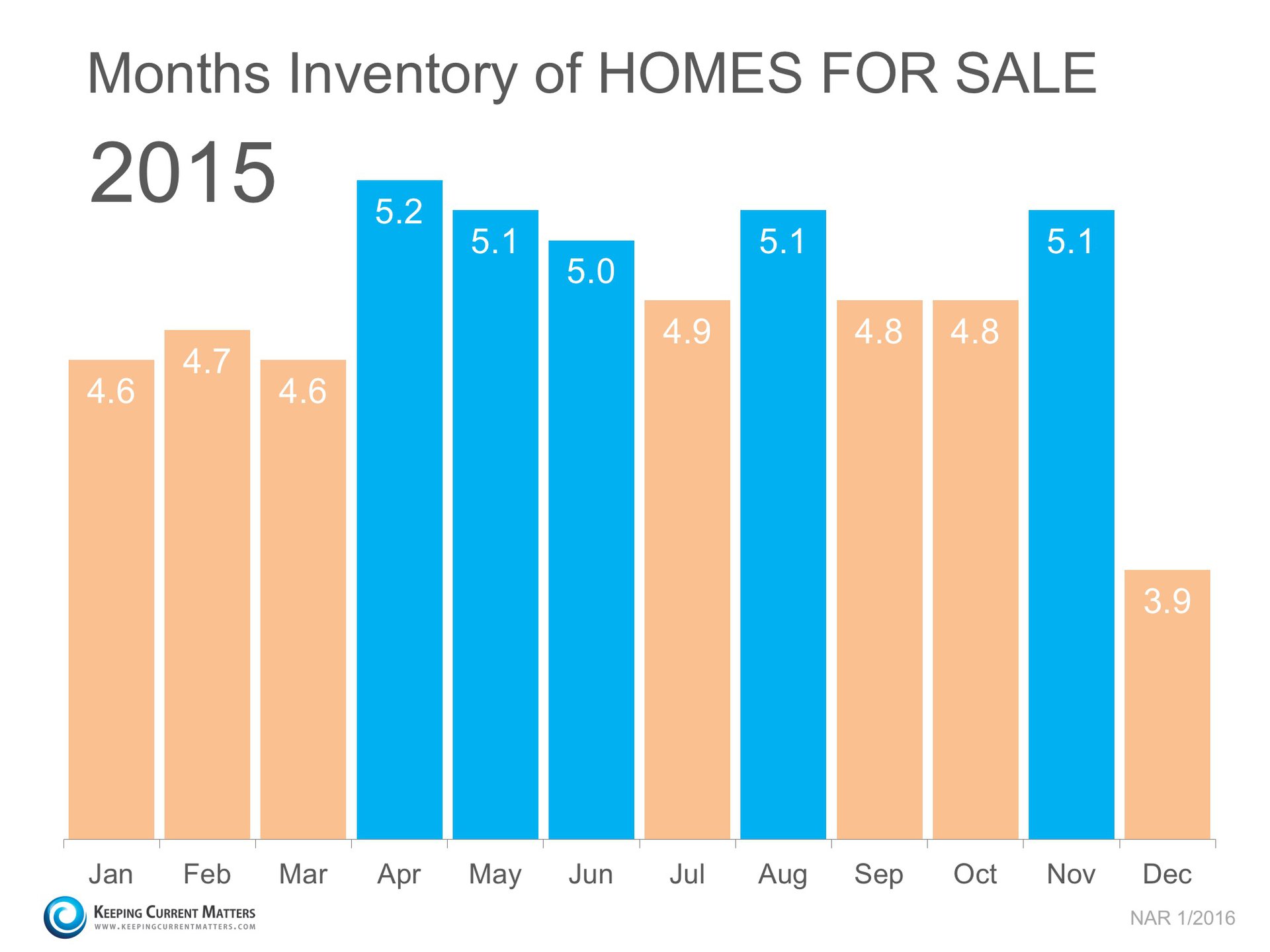
The most important realization to come out of the report is the fact that inventory of existing homes for sale dropped dramatically from a 5.1-month supply in November to the lowest figure since January 2005, at a 3.9-month supply.
A normal market, where prices rise with inflation, is defined as having a 6-7-month supply of homes for sale. As you can see in the chart below, inventory levels in 2015 were at or below a 5.2-month supply for the entire year.
2015 Months Inventory of Homes For Sale | Keeping Current Matters
If inventory levels do not recover, this could be a challenge for sales moving forward as buyer demand remains strong and competition for the homes that are on the market continues to rise.

Bottom Line

If you are considering listing your home for sale in 2016, now is the time! With inventory levels at their lowest mark in over 10 years, listing your home for sale before the busy spring buying season will give you the most exposure to buyers and allow you to get the best price for your home.

Monday, January 18, 2016

Thinking of Buying? Selling? 5 Reasons You Need To Hire A Professsional

Thinking of Buying? Selling? 5 Reasons You Need To Hire A Professsional | Keeping Current Matters
Whether you are buying or selling a home, it can be quite an adventurous journey. You need an experienced Real Estate Professional to lead you to your ultimate goal. In this world of instant gratification and internet searches, many sellers think that they can For Sale by Owner or FSBO.
The 5 Reasons You NEED a Real Estate Professional in your corner haven’t changed, but have rather been strengthened due to the projections of higher mortgage interest rates & home prices as the market continues to recover.

1. What do you do with all this paperwork?

Each state has different regulations regarding the contracts required for a successful sale, and these regulations are constantly changing. A true Real Estate Professional is an expert in their market and can guide you through the stacks of paperwork necessary to make your dream a reality.

2. Ok, so you found your dream house, now what?

According to the Orlando Regional REALTOR Association, there are over 230 possible actions that need to take place during every successful real estate transaction. Don’t you want someone who has been there before, who knows what these actions are to make sure that you acquire your dream.

3. Are you a good negotiator?

So maybe you’re not convinced that you need an agent to sell your home. However, after looking at the list of parties that you need to be prepared to negotiate with, you’ll realize the value in selecting a Real Estate Professional. From the buyer (who wants the best deal possible), to the home inspection companies, to the appraiser, there are at least 11 different people that you will have to be knowledgeable with and answer to, during the process.

4. What is the home you’re buying/selling really worth?

It is important for your home to be priced correctly from the start to attract the right buyers and shorten the time that it’s on the market. You need someone who is not emotionally connected to your home to give you the truth as to your home’s value. According to the National Association of REALTORS, “the typical FSBO home sold for $210,000 compared to $245,000 among agent-assisted home sales.”
Get the most out of your transaction by hiring a professional.

5. Do you know what’s really going on in the market?

There is so much information out there on the news and the internet about home sales, prices, mortgage rates; how do you know what’s going on specifically in your area? Who do you turn to in order to competitively price your home correctly at the beginning of the selling process? How do you know what to offer on your dream home without paying too much, or offending the seller with a low-ball offer?
Dave Ramsey, the financial guru advises:
“When getting help with money, whether it’s insurance, real estate or investments, you should always look for someone with the heart of a teacher, not the heart of a salesman.”
Hiring an agent who has their finger on the pulse of the market will make your buying/selling experience an educated one. You need someone who is going to tell you the truth, not just what they think you want to hear.

Bottom Line

You wouldn’t replace the engine in your car without a trusted mechanic. Why would you make one of your most important financial decisions of your life without hiring a Real Estate Professional?

Monday, January 11, 2016

Thinking of Buying a Home? 3 Questions Every Buyer Should Answer First

Thinking of Buying a Home? 3 Questions Every Buyer Should Answer First | Keeping Current Matters
If you are debating purchasing a home right now, you are probably getting a lot of advice. Though your friends and family will have your best interest at heart, they may not be fully aware of your needs and what is currently happening in the real estate market.
Answering the following 3 questions will help you determine if now is actually a good time for you to buy in today’s market.

1. Why am I buying a home in the first place?

This truly is the most important question to answer. Forget the finances for a minute. Why did you even begin to consider purchasing a home? For most, the reason has nothing to do with money.
A study by the Joint Center for Housing Studies at Harvard University reveals that the four major reasons people buy a home have nothing to do with money. They are:
  • A good place to raise children and for them to get a good education
  • A place where you and your family feel safe
  • More space for you and your family
  • Control of that space
What does owning a home mean to you? What non-financial benefits will you and your family gain from owning a home? The answer to that question should be the biggest reason you decide to purchase or not.

2. Where are home values headed?

According to the latest Home Price Index from CoreLogic, home values are projected to increase by 5.3% over the next 12 months.
What does that mean to you? 
Simply put, if you are planning on buying a home that costs $250,000 today, that same home will cost you an additional $13,250 if you wait till next year. Your down payment will need to be higher as well to account for the higher home price.

3. Where are mortgage interest rates headed?

A buyer must be concerned about more than just prices. The ‘long term cost’ of a home can be dramatically impacted by even a small increase in mortgage rates.
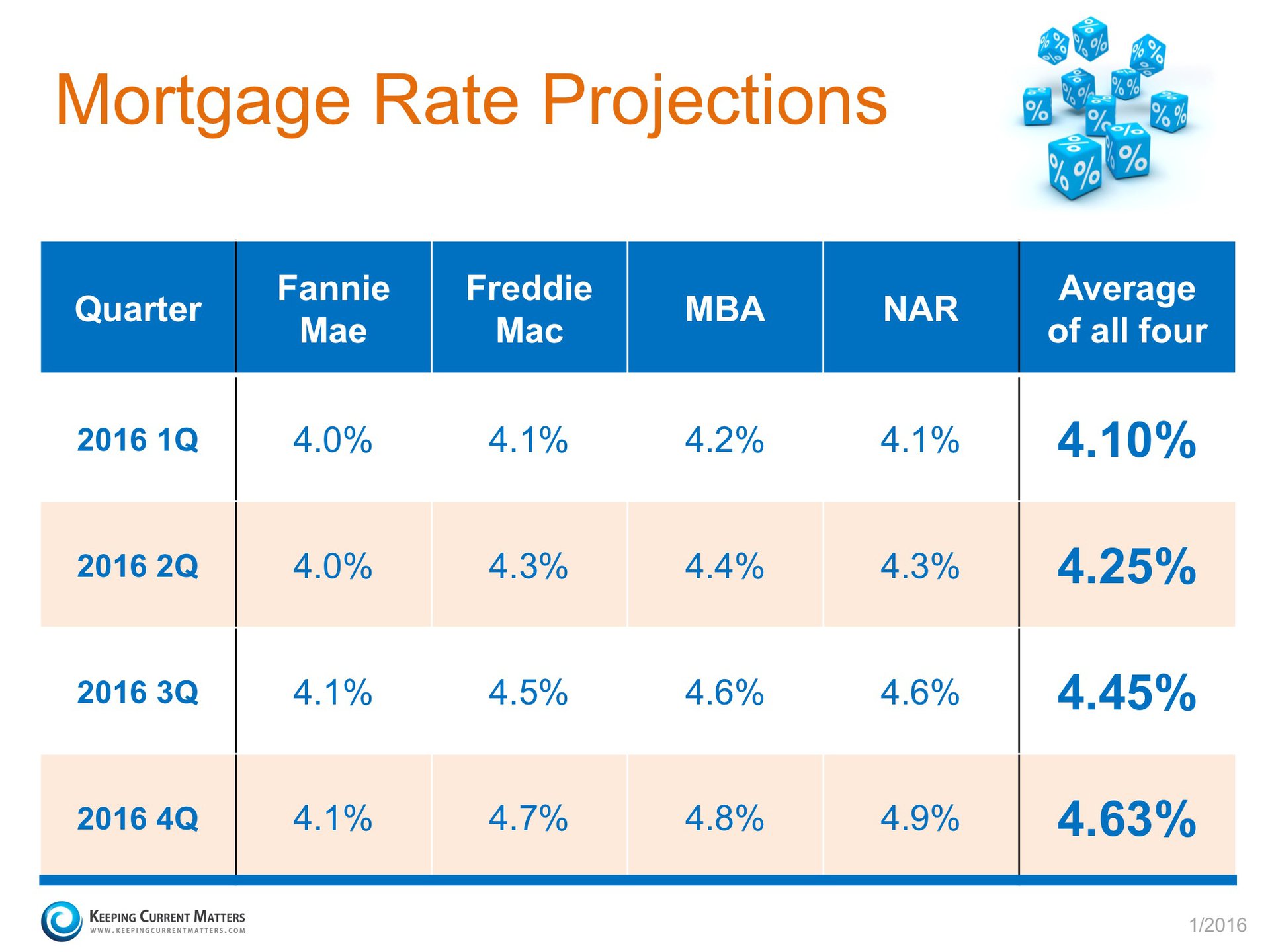
The Mortgage Bankers Association (MBA), the National Association of Realtors and Freddie Mac have all projected that mortgage interest rates will increase by approximately three-quarters of a percent over the next twelve months as you can see in the chart below:
Mortgage Rate Projections | Keeping Current Matters

Bottom Line

Only you and your family will know for certain if now is the right time to purchase a home. Answering these questions will help you make that decision.

Monday, January 4, 2016

Top Reason to List Your House For Sale Now!

Top Reason to List Your House For Sale Now! | Keeping Current Matters
If you are debating listing your house for sale this year, here is the #1 reason not to wait!

Buyer Demand Continues to Outpace the Supply of Homes For Sale

The National Association of REALTORS’ (NAR) Chief Economist, Lawrence Yun recently commented on the inventory shortage:
“While feedback from REALTORS® continues to suggest healthy levels of buyer interest, available listings that are move-in ready and in affordable price ranges remain hard to come by for many would-be buyers.”
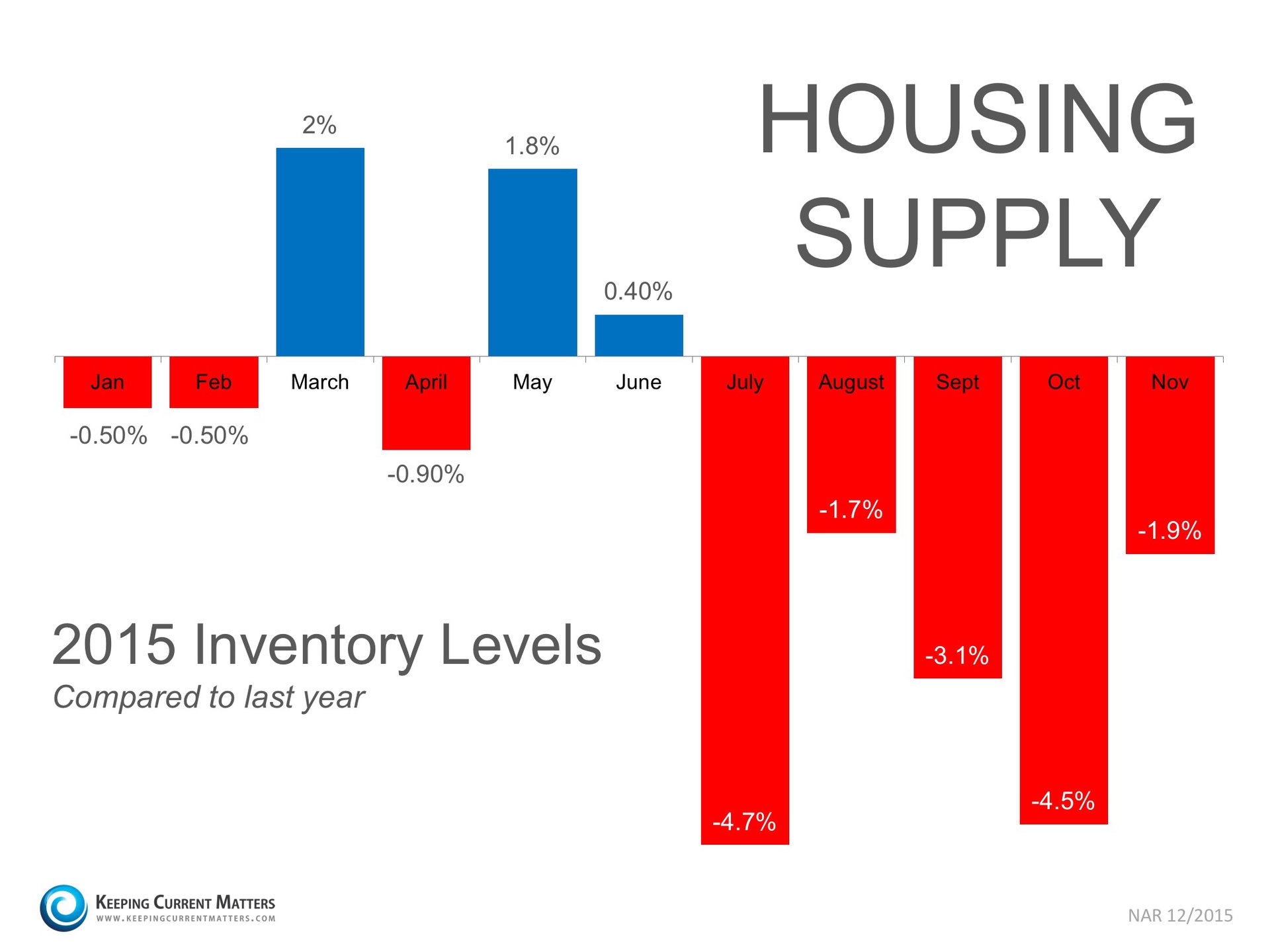
The latest Existing Home Sales Report shows that there is currently a 5.1-month supply of homes for sale. This remains lower than the 6-month supply necessary for a normal market and well below November 2014 numbers.
The chart below details the year-over-year inventory shortages experienced in 2015:
Housing Supply Year-Over-Year | Keeping Current Matters
Anything less than a six-month supply is considered a “Seller’s Market”.

Bottom Line

Meet with a local real estate professional who can show you the supply conditions in your neighborhood and assist you in gaining access to the buyers who are ready, willing and able to buy now!

Monday, December 28, 2015

Why Did Home Sales Drop So Dramatically Last Month?

Why Did Home Sales Drop So Dramatically Last Month? | Keeping Current Matters
Yesterday, the National Association of Realtors (NAR) released their latest Existing Home Sales Report which covered sales in November. The report revealed that sales:
“…fell 10.5 percent to a seasonally adjusted annual rate of 4.76 million in November (lowest since April 2014 at 4.75 million)…”
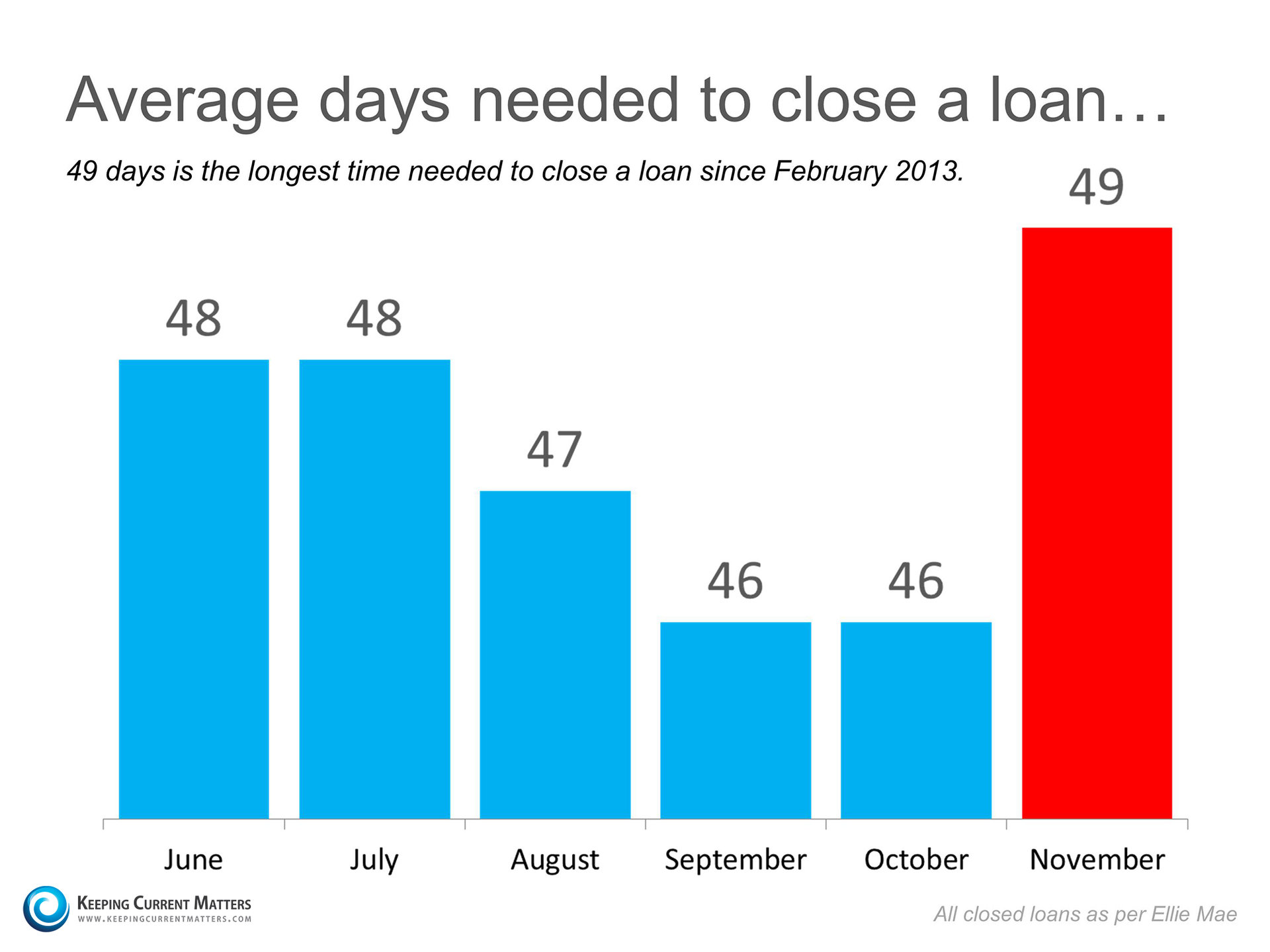
That revelation gave birth to a series of industry articles, some of which quoted pundits questioning whether the housing market was slowing. In actuality, there is one rather simple explanation to much of the falloff in sales last month. It is likely the implementation of the “Know Before You Owe” mortgage rule, commonly known as the TILA-RESPA Integrated Disclosure (TRID) rule, which went into effect on October 3. These regulations caused house closings to be delayed by an extra three days in November as shown in the graph below.
Average Days To Close | Keeping Current Matters
Three days might sound like a minimal difference. However, since there are only approximately 20 days in a month that a closing would normally take place (Mondays through Fridays), losing three days constitutes well over 10% of all closings. These sales are not lost. They are just moved into the next month’s numbers. In a DS News article on the subject yesterday, Auction.com EVP Rick Sharga explained:
“The most likely cause for the weak sales numbers is a delay in processing loans due to the new TRID mortgage requirements imposed by the CFPB. This is the biggest change in mortgage document processing in many years, and there have been numerous reports within the industry of problems implementing the process and the new documentation that comes with it.”

So how is the housing market actually doing?

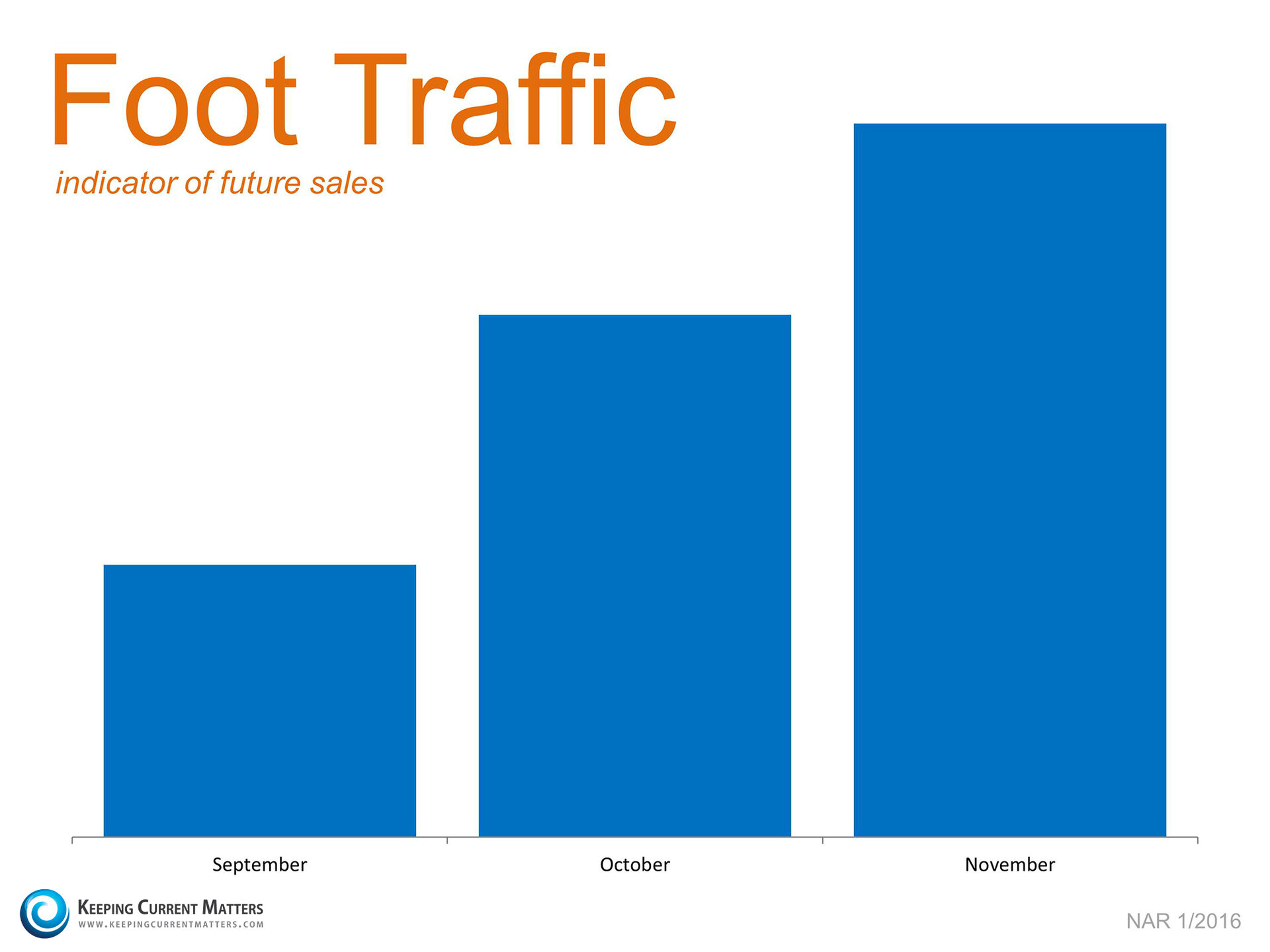
A better way to look at how well the housing market is doing is to look at the Foot Traffic Report from NAR which quantifies the number of prospective buyers that are actively looking for a home at the current time:
Foot Traffic Growing | Keeping Current Matters
We can see immediately that demand to buy single family homes is increasing over the last few months - not decreasing.

Bottom Line

No matter what last month’s sales numbers show, the housing market is still doing well as demand remains strong.

Monday, December 14, 2015

You Will Need to Sell Your Home Twice

You Will Need to Sell Your Home Twice | Keeping Current Matters
recent post on “The Home Story”, a site published by Fannie Mae, explained the difference between the price a seller may get for their home and the value an appraiser might assign the property.

The Sales Price

Of course, most sellers want to maximize the value they get for the house. However, the price they set might not be reflective of the other comparable homes in the neighborhood. As the article stated:
“People tend to view their homes emotionally, and that can become quickly apparent when they decide to sell.”
That doesn’t mean that the home won’t necessarily sell for that price.
A seller can set an asking price and actually have a buyer agree to that price. However, that value may not be necessarily in agreement with what most buyers are willing to pay. For example, one person can view a property, determine it is exactly what they are looking for and well worth the asking price, whereas another person could look at the same property and feel the asking price is too high.
Steven Corbin, Director of Valuation in Fannie Mae’s CPM Real Estate division gives an example:
“Someone may have driven by the property countless times, and they really want to live in that house. So in reality they may overbid for that property. This would be a situation where the actions of a specific buyer do not represent the actions of a typical buyer.”

The Appraised Value (or Market Value)

Fannie Mae explains what they look for when appraising the house:
“When a contract is established on a property, an appraised value is determined by a professional real estate appraiser. The appraiser works on the lender’s behalf to determine that value by taking many factors into consideration, including the neighborhood, the value of properties of similar size and construction, and even such things as the type of fixtures on the premises and layout of the floor plan.”
Corbin adds:
“From a lending perspective, a bank would want to know the probable price a typical buyer would offer for the property. That’s what an appraiser would set as the market value.”

The Challenge when Sales Price and Appraisal Value are Different 

If the appraiser comes in with a value that is below the agreed upon sales price, the lending institution might not authorize the mortgage for the full amount a buyer would need to complete the transaction.
Quicken Loans actually releases a Home Price Perception Index (HPPI) that quantifies the difference between what sellers and appraisers believe regarding value. The HPPIrepresents the difference between appraisers’ and homeowners’ opinions of home values.
Currently, there is approximately a 2% difference between what homeowners believe their home to be worth and what appraisers value that same home. On a $300,000 sale that would be a $6,000 difference. That could be a challenge that might prevent the home sale proceeding to the closing table.
Quicken Loans Chief Economist Bob Walters recently commented on this issue:
“The more homeowners are in line with appraisers, the easier it will be to refinance their mortgage and easier for those looking to buy a home. If the two are aligned, it eliminates one of the top stumbling blocks in the mortgage process.”

Bottom Line

Every house on the market has to be sold twice; once to a prospective buyer and then to the bank (through the bank’s appraisal). In a housing market where supply is very low and demand is very high, home values increase rapidly. One major challenge in such a market is the bank appraisal. If prices are jumping, it is difficult for appraisers to find adequate comparable sales (similar houses in the neighborhood that closed recently) to defend the price when performing the appraisal for the bank.
With escalating prices, the second sale might be even more difficult than the first.That is why we suggest that you use an experienced real estate professional to help set your listing price.